What to Do When Your Cat Is Peeing Outside the Litter Box
When your cat is peeing outside the litter box, it’s incredibly frustrating, and upsetting. But I don’t need to tell you that!
So, I want you to take a deep breath with me, and know that it can get better. Now I want you to start shifting your perspective on how you look at the situation with your cat. Think of your cat as a very good communicator, and everything they do (and don’t do!) is their way of trying to tell you something.
But the thing is… They’re speaking one language, and you’re speaking another. You may be speaking languages that are relatively close and sometimes even sound similar, like English and Spanish…
Or you might be speaking English and they’re communicating in Russian by using sign language.
I want to share a little story. One morning I woke up and played with the cats like I normally do when I wake up. Doja, being around 8 months old, was extra hyper. And even after our play session he kept jumping on Ellie, my fluffy adult female cat. (Learn more about Doja here.)
So, I decided to shut the bedroom door while he was in there, just while I got their breakfast ready. A few minutes later, I heard a lot of crying coming from the bedroom.
Doja is a noisy little boy most of the time, so I didn’t think much of it. Pretty soon the crying stopped, and not long after I opened the door to bring his breakfast in, I realized that there was a puddle of pee on my bed, right on the side I sleep on.
Now, I’m only human, so my first instinct was to feel extremely frustrated.
It was upsetting. But I know that cats are excellent communicators, if you learn to understand their language.
I knew there was a perfectly valid reason (from his perspective, not mine) that he had peed outside of the litter box. So, instead of getting mad… I took a deep breath and evaluated the situation.
I know how frustrating it is when your cat uses your stuff like it’s their personal litter box, and helping cat parents get to the bottom of it is just one of the things I love so much about being a Cat Behavior Consultant.
First, Let Me Say Cats Do Not Do Anything to Purposely Upset You
If you take anything away from this post, please let it be the assurance that your cat does not do anything to purposely upset you.
Ever.
They are not doing anything out of spite, or just to make you mad. They’re not doing it to watch you, laughing on the inside, while you have to spray your sheets down with enzymatic cleaner again.
Seriously, I cannot tell you how often I hear this from people, and it breaks my heart. Your cat is reacting the only logical way they know how, to the situation they’re in. They’re acting on instinct, not emotion. Don’t put these negative human qualities on your cat…

Cats are not humans. That’s one of the things most of us love about them.
Below are some steps you can take right away, so you can begin to understand what’s actually going on. I want to share with you what to do, what not to do, the significance of where the deed was done, and the factors that may be influencing this behavior.
1) Clean the Heck Out of Any Place Your Cat Has Peed
Of course, you’re going to want to clean the area/object that your cat has urinated on. But I highly recommend going above and beyond here.
It’s very important that you clean thoroughly with an enzymatic cleaner, and I’ll tell you why. Cat urine contains proteins that are meant to mark territory and not wash away.
Even if you clean it up with a regular cleaner and can’t smell it anymore, trust me when I say your cat will still be able to smell it, and it may trigger them to urinate on that spot again. An enzymatic cleaner will break down those proteins in their urine, and allow you to actually get rid of it. I personally like this cleaner, and many of my clients have had success using it:

2) Do NOT Punish

Now, I know this can be tempting when we don’t know what else to do and we’re frustrated. I get it. There are times when I want to get upset and yell. But I promise you, this is not going to work.
Not only does your cat have no clue why they’re being punished, but they don’t even understand that what they did would be upsetting.
This is because, unlike most humans, cats do not think in terms of right and wrong. So, they don’t even realize that what they did is wrong in the first place. Remember how I just said cats are not humans? That applies here as well. Wrong is a human viewpoint, not a cat viewpoint.
And furthermore, punishing them [such as with a squirt bottle, rubbing their face in it, hitting (I shouldn’t need to say this, but don’t ever hit an animal), yelling, chasing, etc.] is only going to hurt your relationship with them, and can actually make their litter box issues worse because it stresses them out.
3) Make Sure It’s Not Due to an Illness or Pain
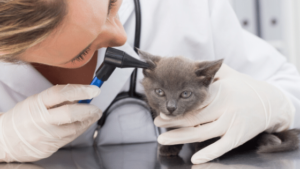
If your cat is going outside of the litter box it’s important to take them to the vet.
Especially if it seems completely unprompted and random. Avoiding the litter box could be indicative of an underlying illness, infection, or even pain, and all of these things need to be ruled out before going any further.
4) Look For Reasons Why They May Have Avoided the Litter Box
Once you rule out a medical issue, you can start tackling things from a behavioral perspective. This is the job I do for many cat parents who can’t figure out how to get their cat to stop peeing outside the litter box. Sometimes it’s a simple fix, other times it takes a very trained eye and some major digging. So let’s get to it.
There are SO many reasons a cat could avoid their litter box, so understand that this list only includes some reasons, not all reasons.
But I do hope it gets you out of frustration mode, and thinking more like a cat behavior consultant. Thinking in terms of communication, rather than anger or the feeling that it’s a personal attack.
Start by looking at anything that’s a disruption to your cat’s normal every day life, or makes going to the litter box more difficult than necessary.
- Have there been any recent changes in your household? New baby, animal, furniture, closing off a room they used to have access to, etc?
- Do they have to climb stairs or go into a separate space, like the garage, to get to the litter box?
- Is their litter box dirty, and do you clean it less than you should? (You don’t have to tell me, but be honest with yourself.)
- Have there been recent visitors?
- Did you go on vacation, or leave for a longer period of time than usual?
- Have you changed cat litters? Or scents?
- Have you added in fragrance spray, deodorizers, plugins, or candles? (Cats are extremely sensitive to scent)
- Is the litter box a good place for a cat to get ambushed by another cat? Or dog? (Feeling unsafe or anxious can definitely cause a cat to stop using the litter box.)
- Have there been cats hanging around outside?
All of these factors and many, many more could play a significant role in your cat peeing outside of the litter box.
5) Consider Where They Did Pee
Where your cat did pee can provide a lot of information and help you determine why they did it. Having some understanding of why they did it is incredibly beneficial in helping you come up with a plan for resolving the issue. Here are some questions I dive deep into during Cat Behavior Consultations:
Where did they pee? Why would they have gone in that spot in particular?
Some examples:
-
- Is it a spot where you spend a lot of your time? (bed, couch, etc. This can be a way of communicating with you that they’re feeling insecure and they’re trying to meld their scent with yours in a very extreme way.)
- Did they pee on soft material?
- Does it smell like another cat and they’re trying to mark it?
- Is it in an area where you and the family spend a lot of time, but there is no litter box?
- Is it a spot that may feel unfamiliar/threatening to your cat?
- Is it right next to the box? (Sometimes this is a sign that the litter box setup is the problem.)
- Is it up high? (Maybe there’s a reason they’re feeling more comfortable being higher up.)
- Could it just be a place that seemed suitable when their litter box was too dirty?
- Is it under doors and windows only? (This could possibly be a perimeter marking behavior.)
Now, this is also going to depend on whether or not your cat is continually avoiding the litter box, or if this was a sudden fluke thing. When a cat has been going outside of the litter box for a while, there may be more work involved when it comes to getting them back into the box.
But considering every factor you can think of is going to be very helpful in achieving that resolution I know you so desperately want. Keeping a log so you can track your cat’s litter box behavior can also be extremely helpful, and something I highly recommend doing.
What Actually Happened with Doja

These steps are just a jumping off point to help you start to get inside of your cat’s mind. When I work with clients to help them resolve their cat’s litter box issues, the root cause is typically a mish mash of things that finally caused them to stop using the litter box.
Think of it like a meter, where each factor is filling it up and moving them closer and closer to going outside of the box. And then “all of a sudden” it happens, the meter gets too high and they urinate somewhere else.
For my situation with Doja, it was simply because I had changed the litter in the bedroom from clay to pine pellets, and Doja wasn’t comfortable using it yet. There are normally two litter boxes in there, and I kept one filled with the litter he was used to, but I had taken the other one out to wash it.
So, instead, he found the most comforting socially significant spot to relieve himself. And to communicate what was wrong. It just happened to be the worst spot for me…
Creating harmony between cats and humans in your household is possible when armed with the right information and strategies. Sometimes it’s fairly simple, and other times it takes some serious investigative work.
Feline behavior is a deep topic, that relies on a myriad of factors. So, all I can really do in one post is give you some of the basics. If you need specialized help, book a call with me below.